
Online platforms submitted a staggering 4,538,209,578 statements of reasons to the EU in the six months to October 27, 2026, according to the European Commission's transparency database. The same database reports 42% of those decisions as fully automated, so the other 58% were partly automated or made by people. The DSA applies to any platform with users in the EU, wherever it's based, so US platforms with EU users file them too.
Every one of those statements explains a moderation decision, as Article 17 of the Digital Services Act (DSA) requires. For a Trust and Safety team, much of the work sits between the flag and that explanation, in routing the case, applying the right policy, handling the appeal, and keeping the record a regulator will ask for.
Checkstep and Hive (now Deploy) each detect harmful content across text, images, video, and audio and offer a review dashboard. Here's how they compare on detection, workflow, appeals, regulatory reporting, pricing, and integration, based on each company's own published material.
Checkstep vs Hive at a glance
Checkstep fits teams that want review, appeals, and EU statements of reasons in one system; Hive fits engineering-led teams that want Hive's own detection models, especially for visual content.
| Platform | Best for | Detection | Review and appeals | DSA and Online Safety Act reporting | Pricing |
|---|---|---|---|---|---|
| Checkstep | Teams that want detection, review, and EU reporting in one system | Text, image, video, and audio, with models chosen per policy | Customizable queues, AI reasoning escalation, appeal workflow | Generates statements of reasons, files them to the EU database, automates transparency reports | Not published; book a demo |
| Hive (now Deploy) | Teams that want Hive's own models through an API | Text, image, video, audio, and AI-generated media from Hive's own models | Arbiter (formerly Moderation Dashboard) with review queues, user actions, and appeals | Dashboard tools and logs presented as DSA compliance support | Published self-serve rates; enterprise use by quote |
What each platform does
Checkstep is an AI content moderation platform that brings detection, policy management, human review, appeals, and DSA reporting into one workflow. It draws on several AI models and lets teams pick one for each policy. Hive, which renamed itself Deploy on October 26, 2026, is an AI company whose moderation suite pairs its own detection models with Arbiter, formerly the Moderation Dashboard, for review and enforcement.
Hive leads with its models, and Hive's moderation homepage says it processes "billions of pieces of online content" every month. Our platform page leads with policies, moderation queues, and compliance tooling, with the models plugged in underneath.
How we compared
Every claim about Checkstep or Hive comes from that company's own public pages or documentation, checked on October 27, 2026. We compared them on detection, policy workflow, human review and appeals, regulatory reporting, pricing, and integration, the six things a Trust and Safety lead weighs when shortlisting.
Detection coverage in Checkstep and Hive
Detection coverage is close to even. Checkstep and Hive both moderate text, images, video, and audio, and both handle the harms Trust and Safety teams see every day, such as hate speech, harassment, nudity, and child safety. Hive builds its own models, and Checkstep connects to several.
Visual content is where Hive publishes the most detail on its class coverage. Hive's visual moderation page lists "90+ subclasses across major Trust & Safety categories, delivered in a single API response."
Evasion gets similar attention, and Hive's text moderation page says its text model is designed to handle "misspellings, leetspeak, repeated characters, character substitutions, and other evasive tactics." Hive's pricing page also lists detection for AI-generated images, video, audio, and music.
Checkstep takes a model-agnostic route, with an AI marketplace that connects to large language models from multiple providers. Its policy engine lets a team choose the model for each use case, so a hate speech policy and a nudity policy can each run on the model that suits it.
Policy and moderation workflow
Between a model's score and a moderator's decision sit the rules that route each case. Hive's Arbiter lets teams set custom rules, actions, and thresholds and route posts and users to manual review. Checkstep's policy engine works at the level of the written policy, with an AI reasoning model, Advanced ModBot, handling suspicious content and passing the hard calls to moderators.
Hive's Arbiter page describes "a central place to define custom rules and actions" and says teams can adapt policies from the interface with "no code required." That suits teams who like to think in thresholds, such as sending anything above one score for review and removing anything above another.
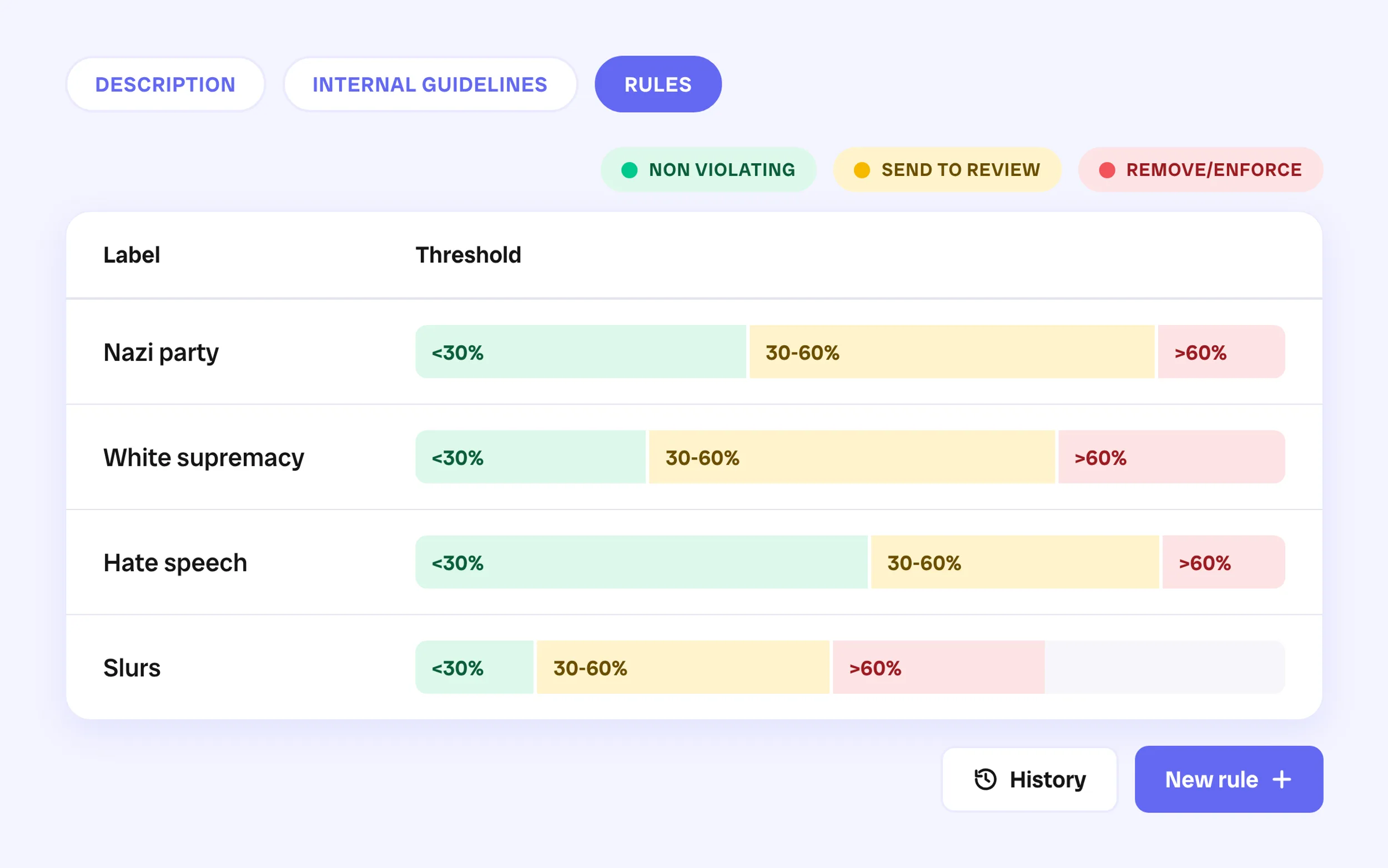
On the Checkstep side, the policy engine covers policy types such as hate speech, child safety, fraud, and violent extremism, and lets teams create policies, edit their descriptions, and pick models for each. Content the models mark as suspicious goes to Advanced ModBot, which applies policy updates immediately and escalates to a human when it's unsure.
Human review, case management, and appeals
Moderators get review queues, user actions, and appeal handling on either platform, so the choice turns on how deep each goes and how you buy it. Hive sells its version through its sales team, while Checkstep ties its appeal workflow directly to DSA reporting.
Hive's Arbiter covers "the full lifecycle of each post," the Arbiter page explains, "from the initial report to potential appeals against your moderators' decision." It also keeps moderation history, supports bans, and links reporting of child sexual abuse material (CSAM) to the National Center for Missing & Exploited Children (NCMEC). Teams request Arbiter access through Hive's sales team.
Inside Checkstep, the dashboard offers customizable queues and sorts content by severity, content type, or policy, so urgent cases reach moderators first. Its appeal workflow runs in the same system that records the violated policy on every enforcement, so the record behind each decision is ready when an appeal turns into a regulatory question.
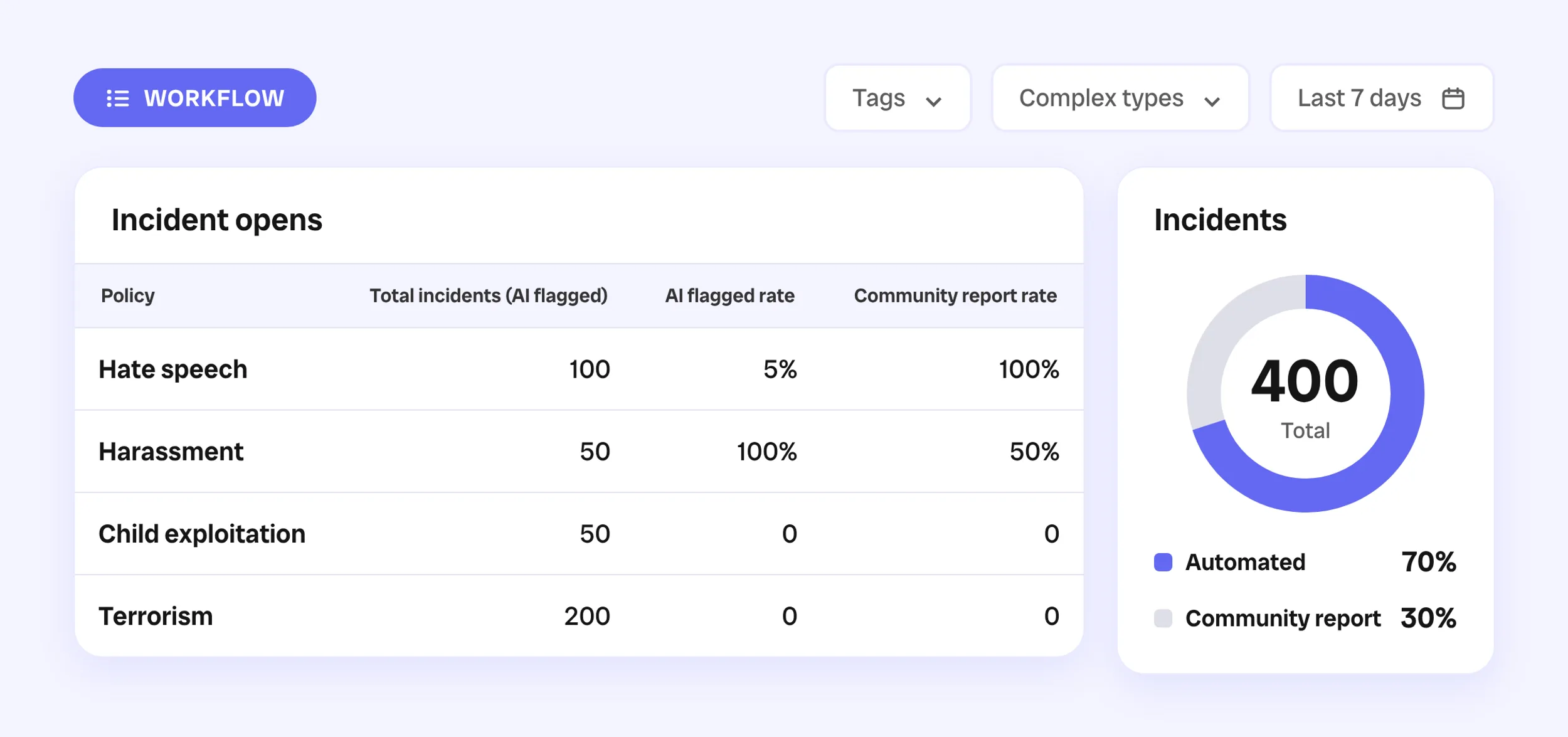
Our page on content moderation for gaming shows how teams ban or suspend repeat offenders.
DSA and Online Safety Act reporting
Checkstep's DSA plugin generates statements of reasons, files them to the EU's database, handles notices and appeals, and automates transparency reports. Hive's Arbiter offers tools and moderation logs that Hive presents as support for DSA compliance.
What the DSA asks of platforms
The DSA, Regulation (EU) 2022/2065, asks online platforms to enforce their terms and conditions diligently (Article 14) and act on notices (Article 16). Each restriction needs a statement of reasons (Article 17), filed to the Commission's database (Article 24(5)). Platforms also need a free appeals system (Article 20) and transparency reports (Articles 15 and 24, with Article 42 for very large online platforms).
Once customers connect their EU Transparency Database API token, Checkstep's plugin files decisions and statements of reasons automatically. The plugin supports compliance through DSA-ready reporting, and the obligations stay with the platform.
Our guide to the EU Digital Services Act summarizes what the law requires of platforms.
What the Online Safety Act adds
For UK services, the UK Online Safety Act 2023 adds record-keeping duties (section 23) and Ofcom transparency reports for categorized services (section 77 and Schedule 8). Our homepage presents the same records, appeals, and reporting as Online Safety Act support.
Our guide to the UK Online Safety Act summarizes what it requires of regulated services.
Checkstep and Hive moderation pricing
Hive publishes self-serve rates for its detection models and prices higher limits, Arbiter, and enterprise use by quote. Checkstep doesn't publish prices and invites you to book a demo, so any fair comparison starts with your own volumes and content types.
Hive's pricing page, now on Deploy's site and checked on October 27, 2026, lists visual moderation at $3.00 per 1,000 requests and text moderation at $0.50 per 1,000 requests, each capped at 100 requests a day. Audio moderation and higher limits are listed as "Contact Sales," and video runs at "special video rates" through Hive's sales team.
Hive's documentation labels the 100-requests-a-day text tier "For developer testing ONLY" and says text moderation needs an annual contract, while pointing smaller customers to its self-serve vision-language model (VLM). For production volumes on Hive's moderation models, and on Checkstep, expect a quote. When you compare those quotes, include the review tooling, reporting, and engineering time around detection.
Languages, scale, and integration
Language coverage favors Checkstep on paper. Our homepage says Checkstep processes 100+ languages natively and supports others through translation, while Hive's text moderation documentation lists around 30 languages, with coverage that varies by language and class.
On integration, our platform page quotes sub-50 millisecond latency and says integration takes "a small amount of engineering work to send Checkstep content via an API." Hive's enterprise commitments page lists SOC 2 Type II compliance and deployment via API, on-premises, or in a custom cloud. We're also SOC 2 Type II certified, as our security statement sets out.
How to choose the right fit
Whether Checkstep or Hive suits your team depends on what happens after the flag. We call it the after-the-flag test.
Start with your monthly volume by content type, your EU and UK user base, and how your review team works today. Together, they show whether you need statements of reasons and transparency reporting generated alongside review, or Hive's own models and Arbiter for a detection-led operation. Our list of 10 questions to ask when choosing a moderation partner helps turn the answers into a vendor shortlist.
Where Checkstep is the better fit
Checkstep suits teams with EU users who want statements of reasons, database filing, appeals, and transparency reports handled in the same system as review. It also fits teams that want to choose models per policy, moderate in many languages, or keep an AI reasoning layer between the models and their moderators. Marketplace teams can see how that applies to their sector on Checkstep's content moderation for marketplaces page.
Where Hive is the better fit
Engineering-led teams that want Hive's own models, especially for visual content and AI-generated media, integrated through an API, will find Hive the closer match. Hive is also a natural pick for teams that already run their own review pipeline or need on-premises deployment. If that's you, our guide to build versus buy for content moderation helps you price the review tooling you'd build and run yourself.
Frequently asked questions about Checkstep vs Hive
What is the best content moderation software?
The best content moderation software for your team is the one that holds up on a labeled sample of your own content. Ask each vendor for precision and recall per policy on that sample, and for how a reviewer overturns a wrong decision. Our guide to the best content moderation companies, tools, and software compares five platforms, including Checkstep and Hive.
Is Checkstep or Hive better for DSA and Online Safety Act compliance?
Checkstep is the closer fit for DSA reporting on each company's published material, and the legal duty stays with the platform operator under both laws. Under the DSA, that includes good-faith engagement with certified out-of-court dispute settlement bodies (Article 21). Under the Online Safety Act, it includes written records of risk assessments (section 23).
Does Hive offer human moderation and appeals?
Hive offers human review and appeals through Arbiter (formerly its Moderation Dashboard), sold through Hive's sales team, with custom review queues and appeal handling for your moderators. Hive's API also includes endpoints for creating an appeal and checking its status, so your own app can send user appeals into the same process.
How do Checkstep and Hive price?
Checkstep and Hive price on different models. Checkstep doesn't publish prices and invites you to book a demo, while Hive bills its published moderation rates per request and its DeployVLM model per token. Hive's sign-up page, checked on October 27, 2026, offers $100 of free credit once you sign up and spend $5, and its AI-generated image and deepfake classifier is sold through its sales team.
What companies use Hive?
Companies that use Hive, according to Hive's case studies page, include Yubo, Tango, Chatroulette, Plato, and Highrise, most of them social, live-streaming, or gaming platforms. Those case studies report Yubo launching live streaming, Tango reducing inappropriate content, and Chatroulette closing more than 1.5 million unsafe streams a month.
Ready to take a closer look?
Choosing between Checkstep and Hive comes down to whether your team's toughest safety calls sit in detection itself or in the review, appeals, and EU reporting that follow it. If those later stages are your hardest problems, Checkstep's content moderation platform runs them in one system.
Book a demo with your policies and a sample of your queue to see how Checkstep handles them after the flag, right through to the statement of reasons.
