
Platforms submitted about 4.3 billion content moderation decisions to the EU's DSA Transparency Database in the six months before October 6, 2026, according to the database's own counter.
This guide explains how Trust and Safety teams moderate uploaded and user-generated video, from upload to decision, and what the EU Digital Services Act (DSA) and the UK Online Safety Act (OSA) require.
Video moderation at a glance
- Video moderation is when, after a video is uploaded, the platform vets its content and may take it down or block it if it doesn't meet its policies and regulations. In AI video moderation, models scan each upload and act on clear violations, while trained human reviewers decide the cases that need context and handle appeals.
- Video made up around 75% of all mobile data traffic at the end of 2025, according to Ericsson's Mobility Report traffic update for Q2 2026.
- Unlike static content, video is dynamic and multilayered, packing image, audio, motion, and on-screen text into one stream, so a violation can sit in any channel.
- Under YouTube's Content ID rules, a copyrighted song in the background can trigger a claim that lets the rights owner block the video, though most claimants keep it viewable.
The temporal problem: One video is thousands of frames
Did you know a single ten-minute video recorded at 24 frames per second contains 14,400 individual frames? If you're a moderator watching a video, the harmful content you're looking for won't appear throughout the entire video. It can appear for two seconds around frame 6,000, about four minutes in, and disappear before a reviewer's eye adjusts.
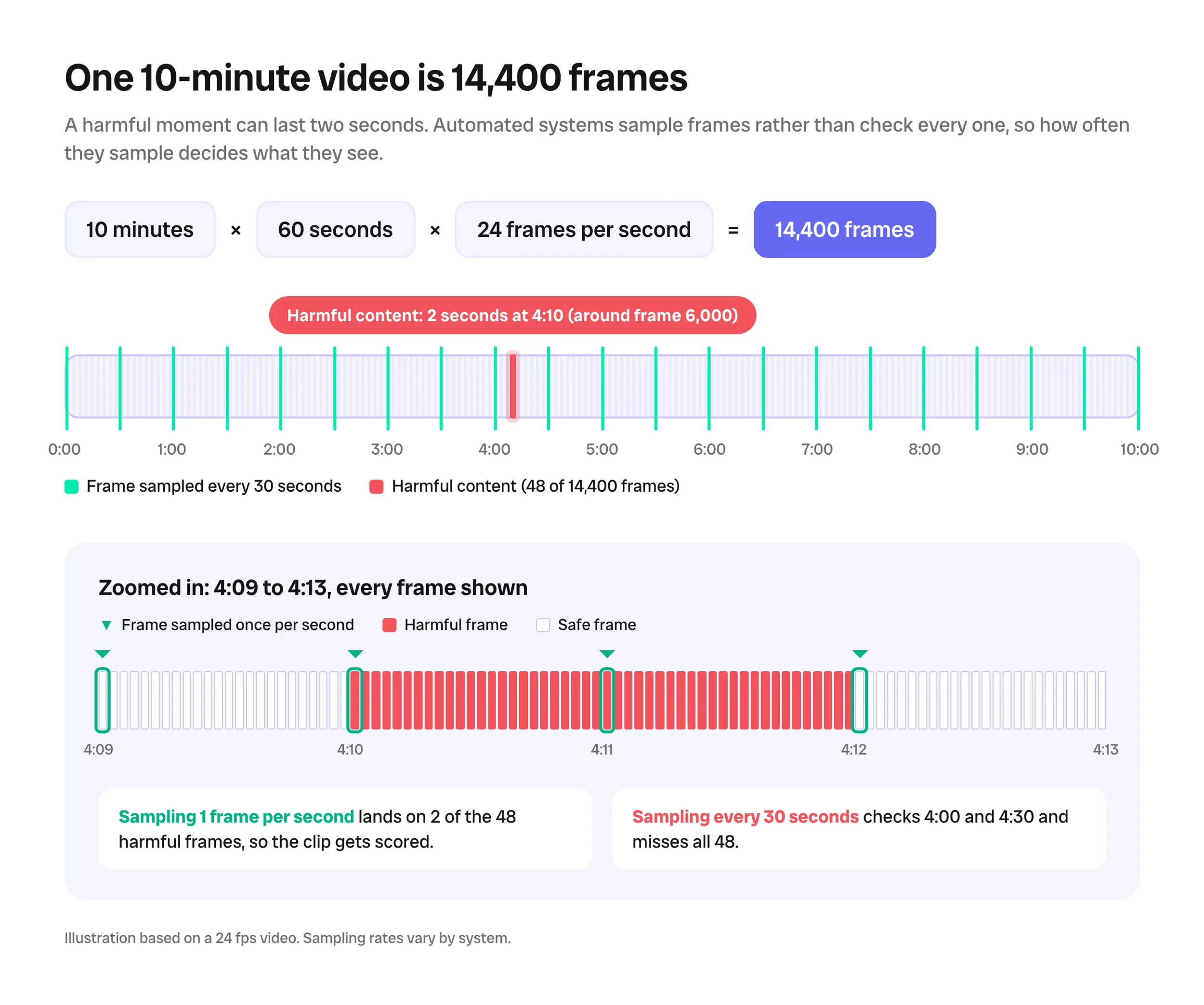
Unlike a photo, which a classifier scores once, video demands judgment across time. Gestures escalate into violence, and jokes turn into harassment. Automated systems sample frames rather than analyze every one, which means moderation often becomes a bet on which slices matter most.
One video, several models at once
A single video rarely gets judged by one model. Visual classifiers scan frames, and a separate audio model listens to the soundtrack; Checkstep's guides to image moderation and audio moderation cover each of those layers.
Motion analysis can add another layer, watching for patterns such as self-harm gestures unfolding across frames. Detecting behavior from movement is still maturing, so these cases go to human reviewers.
Each model scores its own slice of the content, and none of them alone sees the whole picture. The real work happens in how those separate scores get combined into a single decision.
How does video moderation work, from upload to decision?
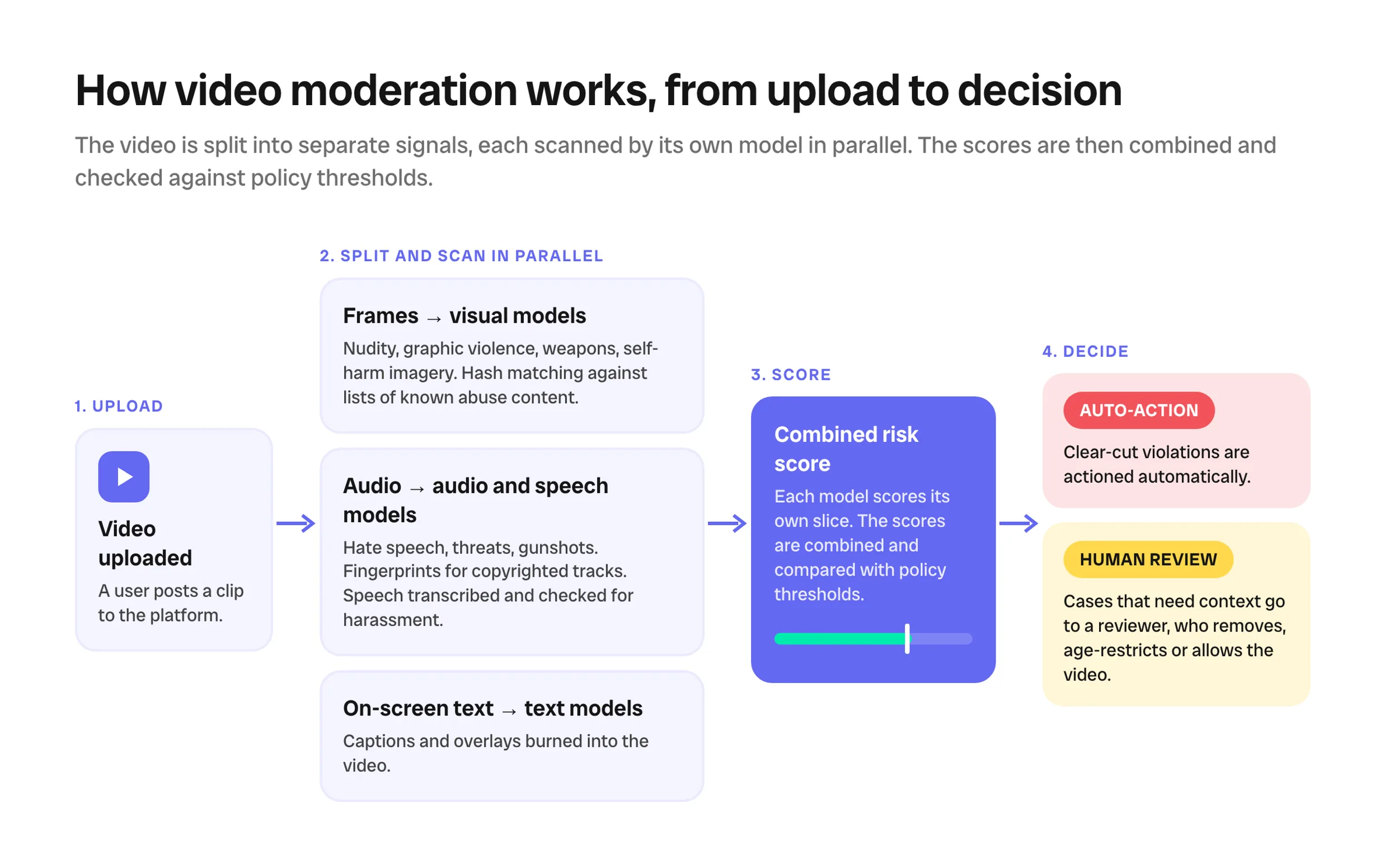
From upload to decision, video content moderation works as a pipeline. A user-generated video gets split into frames, audio, and text, scanned in parallel by separate models, scored for risk against policy thresholds, then either auto-actioned or routed to a human reviewer.
Detecting harm across visual, audio, and on-screen text
Visual detection scans frames for nudity, graphic violence, weapons, and self-harm imagery, sampling at set intervals. Audio detection runs in parallel, listening for hate speech, threats, gunshots, or copyrighted tracks, which fingerprint matching compares against reference files supplied by copyright owners. Speech gets transcribed so a language model can check spoken words for harassment or coordinated abuse, with possible misinformation sent to human reviewers for context.
On-screen text needs its own layer, since captions and text overlays burned into the video can carry violations the soundtrack never contains.
Hash lists from the National Center for Missing & Exploited Children (NCMEC) and the Internet Watch Foundation include known child sexual abuse videos as well as images, so platforms can match new uploads against them.
The moderation queue and severity tiering
Not every flagged video gets treated the same way. Severity tiering sorts content into tiers based on potential harm and confidence score, so a video with a high-confidence match for graphic violence gets pulled immediately, while a borderline case waits for human judgment.
Low-severity, high-confidence violations, like clear spam or copyright matches, can be auto-actioned without a person ever seeing them. Mid-tier content, where a model is unsure, or the potential harm is serious but not urgent, lands in a review queue ordered by risk rather than upload time. High-severity signals, such as suspected child exploitation or imminent self-harm, skip the standard queue and go to a priority queue for immediate human review.
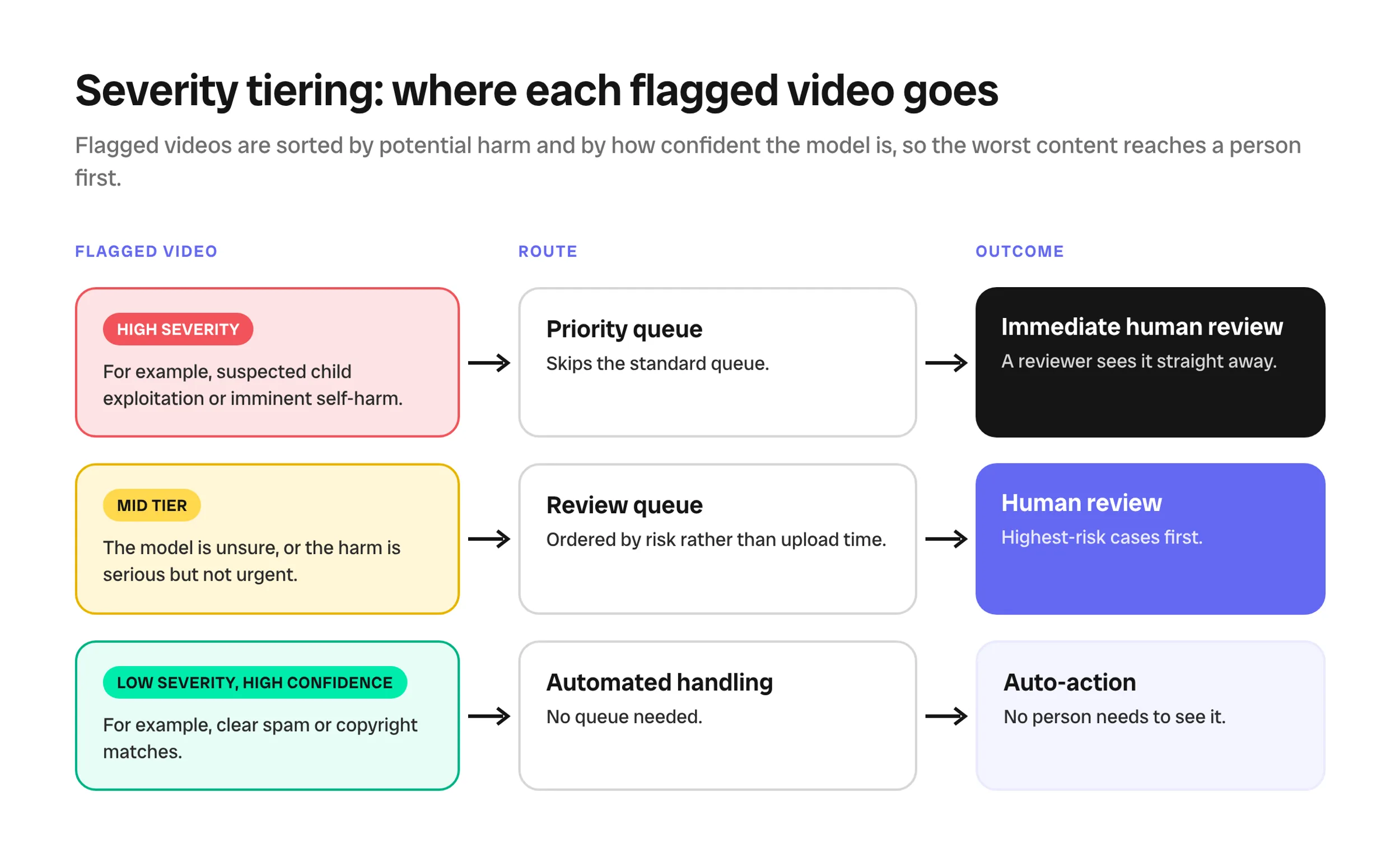
This tiering is what keeps a moderation team from drowning.
Human review and appeals
Human review is built into the pipeline because context, satire, and cultural nuance are still hard for a classifier to judge reliably. Reviewers watch flagged clips and decide whether the content violates policy, needs age-restriction, or is actually fine, using the timestamps that detection models return to jump straight to the flagged moment.
Reviewer well-being matters too, since repeated exposure to graphic material takes a psychological toll. Review tools can blur or grayscale graphic video by default, and a global alliance of content moderators has called for limits on exposure time and access to counseling.
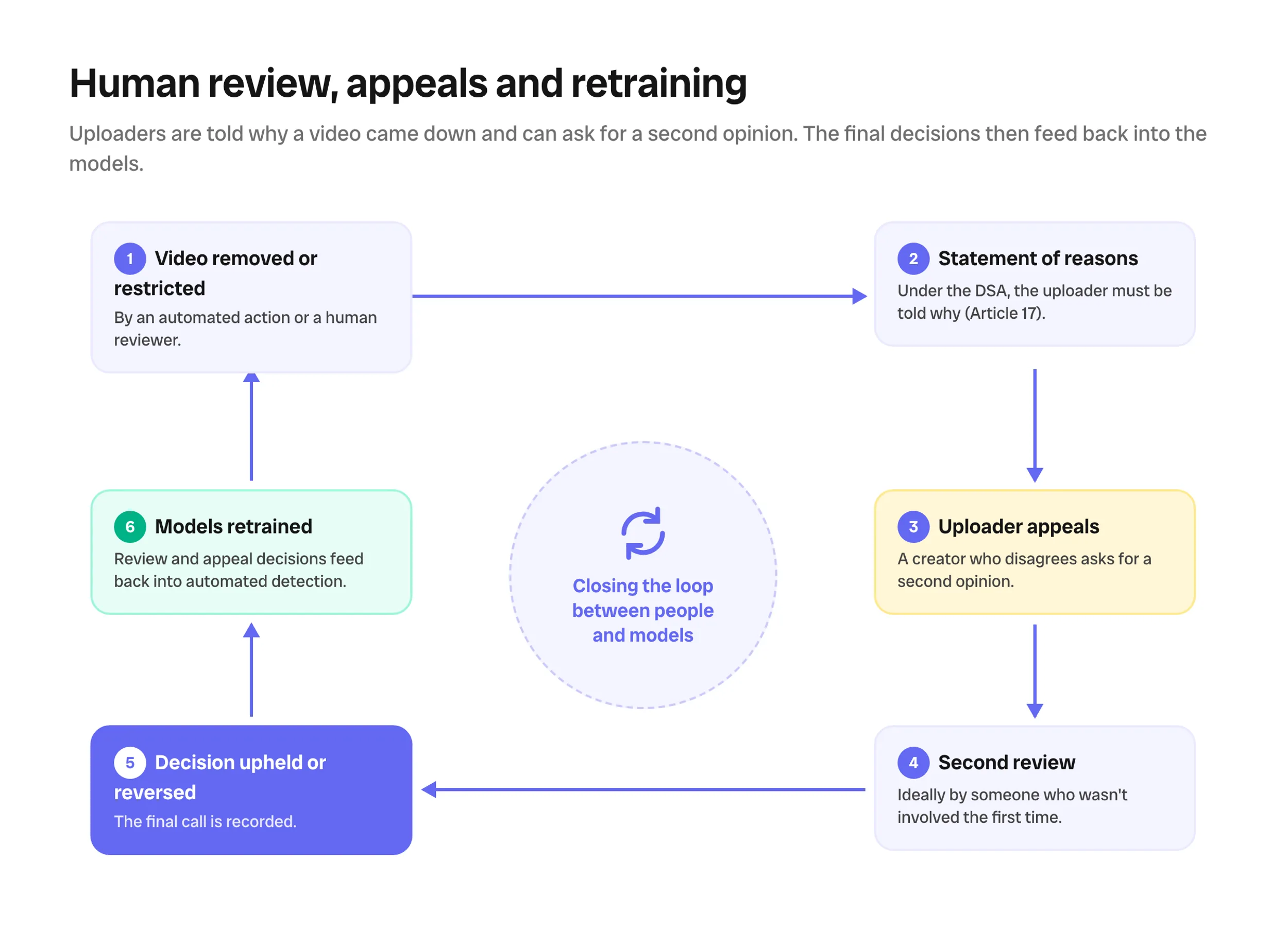
Under the DSA, an uploader whose video is removed or restricted must be told why, in a statement of reasons (Article 17). When a creator disagrees with a decision, appeals give them a route to a second opinion, ideally from someone who wasn't involved the first time. Decisions from human review and appeals can also feed back into retraining, closing the loop between human judgment and automated review.
What do the DSA and Online Safety Act require for video?
The DSA and the Online Safety Act both require platforms to act on reports of illegal content and explain how their moderation works. The DSA applies to US companies that offer services to users in the EU, wherever they are based (Article 2(1)). Providers without an EU establishment must appoint a legal representative there (Article 13).
The OSA reaches US services that have a significant number of UK users or target the UK market (section 4(5)).
Since May 19, 2026, the US TAKE IT DOWN Act has required covered platforms to remove reported nonconsensual intimate images and videos, including AI-generated ones, within 48 hours of a valid request (section 3).
The EU Digital Services Act
The Digital Services Act has been fully applicable since 2024 and covers video platforms under its wider rules for online platforms. The strictest obligations fall on Very Large Online Platforms (VLOPs), which the European Commission designates for having 45 million or more average monthly active users in the EU (Article 33). Non-compliance can bring fines of up to 6% of global annual turnover (Articles 52 and 74).
Here's what that means for video platforms:
- VLOPs must assess systemic risks at least once a year, including risks to elections and to minors (Article 34).
- VLOPs must also take steps to mitigate those risks (Article 35), and mitigation measures can include labeling AI-generated video where manipulation could mislead the public. On a reasoned request from the regulator, VLOPs must give vetted researchers access to data on systemic risks (Article 40(4)).
- Users must be able to flag illegal video easily (Article 16), and notices from trusted flaggers get priority (Article 22). Platforms must act on notices in a timely, diligent way (Article 16(6)) and give affected users a statement of reasons for each restriction (Article 17).
- Serious threats must be escalated. Where platforms suspect a criminal offense threatening someone's life or safety, such as child sexual abuse, they must promptly notify the authorities (Article 18).
- Terrorist content has its own, faster timeline. Under the separate Terrorist Content Online Regulation, platforms must remove terrorist content within one hour of receiving a removal order (Article 3(3)).
- Moderation must be auditable and open to challenge. Online platforms, apart from micro and small enterprises, must offer internal appeals and out-of-court dispute settlement (Articles 20 and 21) and publish transparency reports (Articles 15 and 24). VLOPs also face annual independent audits (Article 37) and six-monthly reports (Article 42).
The UK Online Safety Act
The Online Safety Act places legal duties on platforms that host user-generated video, with Ofcom as the regulator. Those duties include taking down illegal content swiftly once a platform knows about it (section 10). Ofcom can fine companies up to £18 million or 10% of qualifying worldwide revenue, whichever is greater, under Schedule 13 of the Act.
Here's what that means for video platforms:
- Platforms must assess the risks their video content poses. Risk assessments must cover illegal content (section 9). Services likely to be accessed by children must also assess content harmful to children (section 11), including pornography and content that encourages self-harm (section 61) as well as serious violence (section 62).
- Services likely to be accessed by children face additional duties. These include highly effective age checks to keep children from the most harmful content (section 12). Ofcom's codes add feed filtering for children and, on services at higher risk of grooming, safer default settings.
- Users need clear ways to report and complain. Platforms must offer reporting tools and complaints processes (sections 20 and 21).
- Platforms must report child sexual exploitation and abuse (CSEA) content they detect to the National Crime Agency. The duty has applied to user-to-user services since April 7, 2026 (section 66). Providers outside the UK report only UK-linked content, and content already covered by NCMEC reporting needs no second report (section 70).
- Platforms must be transparent and answerable to Ofcom. Categorized services must publish an annual transparency report when Ofcom issues a notice (section 77). For serious, continuing breaches, Ofcom can ask a court to restrict access to a service (sections 144 and 146).
How do platforms detect deepfakes and AI-generated video?
Deepfake detection usually starts with forensic artifacts that models learn to spot, such as inconsistent lighting or shadows and audio that doesn't quite sync with lip movement. These artifacts get harder to catch as tools improve and adversaries adapt to whichever detector is publicly known, so platforms add provenance checks alongside forensic models. In Deepfake-Eval-2024, a CVPR 2026 workshop study of deepfakes circulated in 2024, open-source video detectors scored about 50% lower on AUC, a standard accuracy measure, than on earlier benchmarks.
In September 2026, a Tech Transparency Project investigation found 332 paid Facebook and Instagram ads carrying child sexual abuse imagery that had passed Meta's ad review. Most used a photo of a child manipulated with AI. Meta said the majority of those ads had fewer than 200 impressions.
Provenance checks and watermarks
Standards like C2PA, from the Coalition for Content Provenance and Authenticity, attach cryptographic metadata to content at the point of capture or generation. That creates a tamper-evident record of how a video was made and edited, which platforms can check automatically without guessing from pixels alone. Credentials are optional and can be stripped, though, so their absence proves little.
Some generators embed an invisible watermark in AI-generated video at creation, designed to survive common edits, though strong compression or targeted attacks can weaken or remove it. Human review still matters for ambiguous cases involving public figures or elections, where mistakes carry real consequences.
A readiness self-check for your video pipeline
Before scaling up video moderation, it's worth pausing to audit a few basics that decide whether the pipeline holds up as upload volume grows. Each question below tests one stage, from detection coverage to appeals and the records regulators expect:
- Can your pipeline process video fast enough to catch harm before it spreads, or does review happen well after people have already seen the content?
- Are you scanning audio, on-screen text, and visual frames, or just the video track?
- Do you have a severity tiering system that sends the worst content to a priority queue for immediate human review?
- Is there a clear appeals process, and do disputed cases actually feed back into retraining?
- Can you produce the records and reports the DSA and Online Safety Act expect, such as written risk assessment records and, for larger services, transparency reports?
If any answer is no, that's where to start building today.
What does effective video moderation look like in practice?
In practice, effective video moderation looks like a layered system. Automated models handle the volume, scoring visual, audio, and text signals in parallel and acting automatically on clear-cut violations. Severity tiering routes anything uncertain or high-stakes to human reviewers quickly.
Frequently asked questions about video moderation
What is the difference between video moderation and content moderation?
Video moderation is a specialized subset of content moderation, covering motion, duration, synced audio, and on-screen text within a single asset. It requires frame sampling, audio transcription, and analysis across time that photo or text moderation doesn't, which raises processing costs. Amazon Rekognition's pricing page lists stored-video moderation at $0.10 per minute in its US example, against $0.001 per image for the first million images a month.
Is moderating live-stream video different from moderating uploaded video?
Moderating uploaded video differs from moderating live-stream video because uploads can be scanned before publishing, allowing denser frame sampling and a human check before anyone sees them. Live video is public the moment it streams, so systems sample frames and audio in near real time. By the time they flag a violation, thousands of people may have already seen it.
Livestreams carry the same Online Safety Act duties as uploads (section 55). Checkstep's streaming page covers streaming services.
What content does video moderation detect?
Video moderation detects graphic violence, sexual content, self-harm and suicide content, and hate symbols in frames, and increasingly AI-generated or manipulated video, including deepfakes. Hate speech, harassment, spam and scams, misinformation, and copyright violations rely more on transcripts, on-screen text, fingerprint matching, and human review. Some categories, such as child sexual abuse material and terrorist content, are illegal, so platforms must act on them under laws like the DSA and the Online Safety Act.
How do platforms add video moderation, by API or a managed service?
Platforms can add video moderation through an API, sending video, frames, or audio to a provider's models to be scored. Single frames can be scored synchronously, while full videos are usually processed asynchronously, with results sent back when analysis finishes. Some platforms also use a managed service, adding outsourced human review from business process outsourcing (BPO) firms that work alongside the automated pipeline.
The right choice depends on volume, in-house expertise, and compliance needs.
Where to start with video moderation
If you're building or buying video moderation for the first time, start by mapping what flows through your platform: uploaded clips, comments, or both. That determines whether you can rely on pre-publish review or need to check videos after they're published.
Next, decide what you're detecting for; a gaming platform and a dating app face different risk profiles, and a generic model tuned for neither will underperform on both. From there, teams can start with an API-based provider to handle volume and severity tiering, with trained human reviewers deciding edge cases and appeals. Build your audit trail and transparency reporting in from day one, before a regulator asks.
To see how detection models and human review fit together in one workflow, explore Checkstep's AI content moderation platform, or book a demo to talk through your own video queue with the team.
